
Custom Lanyards & Badges
The badge that starts conversations before you do.
At a trade show you are your lanyard: it is the handshake people read from four metres away. We supply custom lanyards and badges across Europe, woven and printed straps, PVC and recycled card holders, safety breakaway clips, printed with names that turn a crowd into a guest list.
- Woven & printed straps
- Breakaway safety clips
- Recycled card options
-
LANCUP - Lanyard with cup holder 6cm
Regular price From €0,80 EURRegular priceUnit price per -
PULRIC - Retractable badge holder set
Regular price €1,45 EURRegular priceUnit price per -
LADES - Badge holder
Regular price From €0,35 EURRegular priceUnit price per -
DOSENUNO - Phone holder and bottle opener
Regular price €2,45 EURRegular priceUnit price per


Client story · Fieldfisher
400 branded lanyards for a Fieldfisher event in Barcelona
Fieldfisher describes itself as a European law firm. Its events team asked us for branded lanyards for a Fieldfisher event at SLS Barcelona, Sant Adrià de Besòs. We prepared the artwork, the team approved it in writing, and production followed.
- Client
- Fieldfisher
- Quantity
- 400 lanyards
- Design
- Solid white wordmark on both sides of a blue-to-purple gradient
- Venue
- SLS Barcelona, Sant Adrià de Besòs
 View larger
 View larger
“They were great and thank you again so much for your flexibility!”
“We will be sure to recommend you to our European offices for the very efficient service.”
Planning lanyards for your next event?
Tell us the date, the venue and roughly how many guests. We will come back with options, a digital proof and a written timeline.
Lanyards & badges · Buyer’s guide
Lanyards people are happy to wear all day
A lanyard sits at chest height for hours, so everyone your guests meet sees it. Four choices decide how it looks and works: the strap, the width, the print and the hardware. Here is how to get each one right, with every design approved by you before anything is produced.
112 products in this collection
- Strap widths
- 10, 15, 20 and 25 mm flat straps; 5 and 7 mm round cords
- Branding
- Full-colour sublimation, screen print, transfer, laser engraving
- Materials
- Polyester, rPET, cotton, bamboo, silicone, PVC
- Delivery
- Across the 33 European markets we serve
1. The strap
The material sets the feel, the look and which print methods are possible.
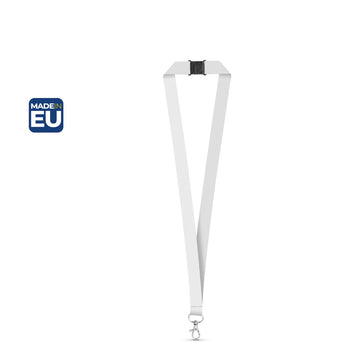 Example: BRISTOL - SET Lanyard SUBLIMATION Long II (20 mm) w...01
Polyester
Smooth, strong and the best canvas for full-colour sublimation, edge to edge on both sides. The everyday choice for conferences and trade fairs.
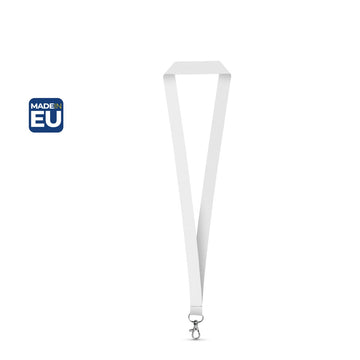 Example: WINDSOR - SET Lanyard SUBLIMATION Long II (20 mm) i...02
Recycled polyester (rPET)
The same smooth finish, made from recycled PET. Several of our sublimation lanyards are 100% rPET.
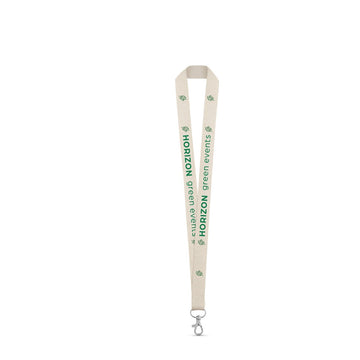 Example: HEATHROW - 100% cotton lanyard03
Cotton and bamboo
A soft, natural feel for creative, hospitality and wellbeing brands. Branded with screen print or transfer, because sublimation needs polyester.
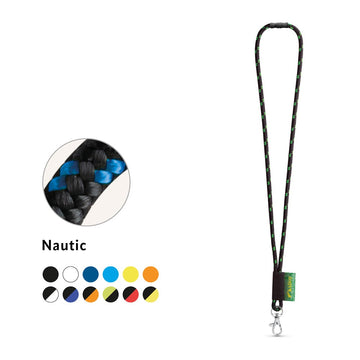 Example: MANSFIELD - SET Lanyard NAUTIC Long (Ø 7 mm) with H...04
Round cords
Tubular and nautical-style cords, 5 or 7 mm thick, for a sporty or design-led look.
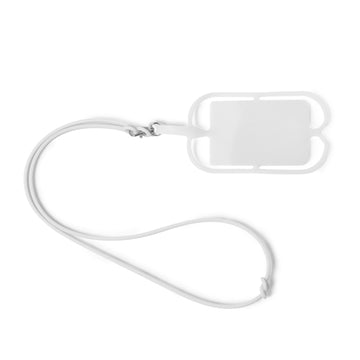 Example: DALVIK - Silicone lanyard05
Silicone and PVC
Wipe-clean and water-resistant, for festivals, pools, kitchens and clinics. Logos are laser engraved or printed.
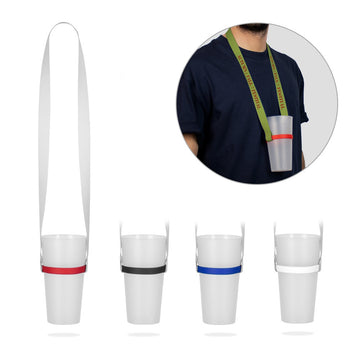 Example: ROTHERHAM - SET Lanyard SUBLIMATION Long II (20 mm)...06
Lanyards with a job
Versions with a cup holder, a phone holder or a retractable card reel turn the lanyard into something people use at the bar, the gate and the desk.
2. The width
Wider straps carry bigger logos; slimmer ones feel lighter and more discreet.
- 10 mm
Slim and discreet, for short straps and minimal wordmarks.
- 15 mm
Light and comfortable; popular for wristband lanyards and short names.
- 20 mm
The classic event width, with room for a repeated logo and a short message.
- 25 mm
Maximum presence for larger logos, sponsor names or wording.
- Ø 5 / 7 mm
Round cords for a clean, minimal look.
Bars drawn to scale
3. The print
Match the method to the strap and to your artwork.
| Method | The look | Best on | Artwork |
|---|---|---|---|
| Sublimation | Full colour, gradients and photos, edge to edge on both sides | Polyester and rPET straps | High-resolution image or vector |
| Screen print | Crisp spot colours matched to your brand | Polyester, cotton and PVC | Vector (AI, EPS or PDF) |
| Transfer | Sharp logos with fine detail, applied with heat | Cotton, bamboo and textured straps | Vector or high-resolution image |
| Laser engraving | A permanent, tone-on-tone mark | Silicone, bamboo, metal clips and badge holders | Vector |
| Doming | A clear, raised resin dome over a printed logo | Clips, reels and tags | Vector or high-resolution image |
Only have a JPG or PNG logo? We can redraw it as vector artwork at no charge.
Lanyards & badges · The details
Clips, badges and a plan that works
The strap gets noticed, but the clip and the badge do the work. Choose them for the way your lanyards will really be used, then plan backwards from the event date.
4. The hardware
Hook trigger snap
The classic swivel clip for badges, cards and keys.
Carabiner
Quick to attach and remove, ideal for keys and tools.
Split ring
A simple key-ring end, often on short lanyards.
Safety breakaway
Releases under a sharp pull. Choose it for schools, hospitals, warehouses, workshops and busy venues.
Retractable reel
Lets staff tap a card on a reader without unclipping it.
Phone holder
Keeps a phone at hand for scanning tickets and taking photos.
Cup holder
A festival favourite: drinks stay in hand, not on the floor.
Duo strap
Two ends, for a phone and a cup or a badge and keys.
5. The badge
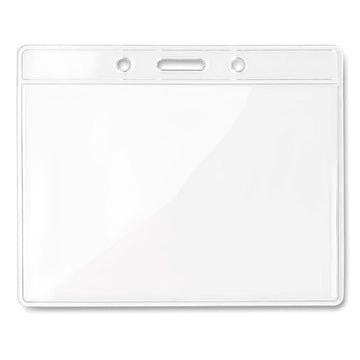 Example: BADGY - Transparent badge 10cmx8cm
Transparent badge holders
Clear pockets in common event sizes, such as 10 × 8 cm and 7.5 × 12.5 cm, for printed name badges.
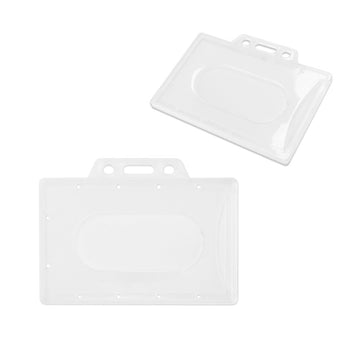 Example: PRYMA - Rigid PP card holder
Rigid ID card holders
Hard-shell holders of 91 × 68 mm take a standard bank-card-size ID of 85.6 × 54 mm, for permanent staff passes.
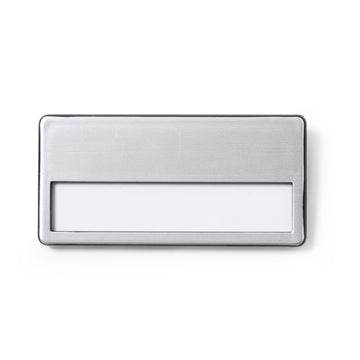 Example: GANDA - Aluminium badge holder
Engraved badge holders
Aluminium holders with a laser-engraved logo for a lasting, premium finish.
Your planning checklist
- Count every badge: staff, speakers, guests, press and a few spares for late registrations.
- Colour-code roles with different strap colours, so the right people are easy to spot.
- Print both sides. Lanyards twist, and a double-sided design keeps your logo facing out.
- Add a safety breakaway wherever people work near machinery, children or crowds.
- Confirm the delivery address early. Hotels and congress centres often have their own goods-in rules.
- Work back from your event date: approval, production and delivery all need time.
From approval to your venue
Artwork approval
We send a digital proof. Nothing is produced until you approve it in writing.
Production
Catalogue lanyards typically take 7 to 14 working days from approval. Made-to-order designs usually need four weeks or more.
Delivery
Shipped with tracking to your office, hotel or venue in any of the 33 European markets we serve.
Every date is confirmed in writing on your quote.
Printed samples are available for several lanyard styles, so you can feel the strap before you commit.
01 / SPECIFICATION AND VALUE
Choose the lanyard before you choose the price.
A useful comparison starts with the job, not the cheapest unit on a spreadsheet. These answers help you define the strap, branding and material before thousands of pieces make a small decision expensive.
01Which lanyard specification is right for a trade show, conference or staff pass?
Start with what the wearer must carry and how often the credential will be handled. A 20 mm polyester or rPET strap is a practical volume baseline because it gives a repeated logo enough space to remain legible. A narrower format can suit a lighter pass or a more discreet identity, while a wider strap can give detailed artwork more presence when the selected range supports it. Cotton, tubular and woven routes create a different feel, but they should earn their place in the brief. Then choose the hook, safety release, detachable buckle, reel and holder around the approved card. There is no universal best lanyard. The best specification is the simplest one that performs every required task without adding cost across the whole quantity.
A strong buying brief separates what is essential from what is merely available. Record the credential dimensions, expected wearing time, indoor or outdoor use, number of handling actions, required branding visibility and the exact audience groups. Then decide which elements can remain identical across the whole order. One common width, attachment and artwork grid normally gives better quantity control than several nearly identical versions. Only introduce another material, colour or fitting when it solves a genuine operational problem. If several options remain credible, compare them on the same quantity and decoration basis so the commercial difference is meaningful.
02When should we choose repeat print, sublimation or a woven lanyard?
Repeat print is usually the most direct route for a clear logo, a limited colour palette and a volume focused order. It works best when the mark can repeat cleanly along the strap and does not depend on photographic detail. Sublimation is better suited to gradients, fine graphics, multiple colours and artwork that needs continuous coverage across the printable surface. A woven design builds the identity into the strap itself and can feel more textile led, but very small lettering and intricate artwork may need simplification. Send the actual logo and campaign design before choosing the method. Swish & Click can compare the realistic print routes against the quantity, visual result, production plan and budget instead of forcing one process onto every project.
Artwork should be reviewed at actual strap width, not only on a large presentation slide. Fine text that looks excellent on screen may become unreadable once repeated along a narrow moving surface. Confirm whether the logo reads in both directions, where each repeat begins, how seams and hardware interrupt the printable area and whether the reverse side matters. Brand teams should identify essential colours and acceptable production tolerances before proofing begins. For a campaign with sponsors, decide whose marks must appear and avoid shrinking every logo simply to include more of them. A clean repeat often gives stronger visibility than a crowded design. The approved method should therefore reflect the final artwork, not a generic preference for a process name such as sublimation or weaving.
03Are rPET and cotton lanyards automatically the most sustainable option?
Not automatically. Material is important, but a credible decision also considers how long the lanyard will be used, whether it will be collected and reused, how many unnecessary versions are produced, the packaging and the delivery plan. The live range includes recycled polyester and cotton options, but environmental wording must follow the documentation for the exact product rather than a general claim about the whole category. Ask us to identify the available evidence and material composition for the shortlisted reference. For a large event, standardising the design, ordering a controlled contingency and avoiding surplus can matter just as much as the fibre choice. A practical lanyard that works across several editions may be a stronger result than a supposedly greener item produced once and discarded immediately.
For procurement and sustainability reporting, retain the product specification supplied for the exact reference, the stated material composition and any evidence supporting a recycled content claim. Do not turn one documented feature into a wider claim about carbon impact, recyclability or circularity unless the relevant evidence exists. The event plan should also define collection points, storage responsibility and whether unpersonalised lanyards can return at the next edition. Keep permanent branding separate from dated content where reuse is important. Accurate headcount, controlled reserve quantities and fewer role variants reduce avoidable surplus. These decisions are practical, measurable and easier to communicate than broad environmental language. Swish & Click can help compare documented options, but the final public claim should always match the approved product and the client’s actual use plan.
04Can we see a sample before approving a large lanyard order?
Yes, sample routes can be checked before a large commitment. Depending on the selected product and production method, this may mean a stock sample to assess the strap and attachment, an existing printed example to judge the decoration, or a project specific preproduction sample. Availability, cost and timing vary, so the sample requirement should be included in the first briefing rather than added after production has been scheduled. A physical sample confirms feel, scale and construction, while the final digital proof confirms the approved logo position, colours and version details. Both have a different purpose. For urgent event orders, we will explain which approval route is realistic and what decision date protects the required arrival date.
Put the sample objective in writing. A stock sample can answer questions about width, softness, stitching, clip movement and holder fit. An existing printed sample can show the general character of a technique, but it cannot guarantee an exact colour match for unrelated artwork. A project sample offers greater confidence, yet may affect the critical path and should only proceed after the basic specification is stable. Record the reference and fittings examined so the approved sample cannot later be confused with a similar product. When it arrives, test it with the real card, clothing and scanner rather than reviewing it only on a desk. Return consolidated comments from one authorised contact. This prevents contradictory approvals and keeps the final production proof as the controlling record for artwork and quantities.
02 / BADGES, ACCESS AND PEOPLE
A badge must work before it looks impressive.
The strap is only one part of the system. Holder size, scanner position, safety, role visibility and personal data determine whether the credential works at a busy entrance.
05How do we choose the correct badge holder, card size and orientation?
Approve the finished insert before selecting the holder. We need the exact card dimensions, horizontal or vertical orientation, material thickness and any punched slot or attachment position. If the badge carries a QR code, barcode or contactless credential, confirm where the reader will meet it and whether the card must remain inside the holder during scanning. A flexible wallet can be economical for event inserts, while a rigid holder can protect a frequently used staff card. A wide conference badge may sit more consistently with two attachment points when the chosen system allows it. Leave enough visual hierarchy for the name, organisation and role to be read quickly. Sending the artwork, card specification and access technology together prevents an attractive lanyard from being paired with a holder that obstructs the actual task.
The finished badge should be tested as a physical system. Measure the insert after printing, folding, laminating or applying any adhesive layer, because nominal artwork dimensions may not equal the final item. Check the holder’s internal capacity as well as its external size, the distance between attachment points and the space needed for a scanner to see the code. If the credential uses NFC or RFID, confirm technical compatibility with the responsible access provider rather than assuming every plastic holder behaves the same. Test whether the card rotates, catches on clothing, reflects light or must be removed too often. For a multi day event, simulate repeated use.
06Does every event lanyard need a safety release or breakaway fitting?
No. A safety release should follow the risk assessment for the real environment, not be added as a decorative label. It may be appropriate where snagging or entanglement is a foreseeable risk, particularly in active workplaces, production areas or settings with specific organiser rules. The chosen fitting, strap and attachment must still be checked as one complete product because designs and release behaviour vary. A safety fitting does not make a lanyard suitable for every hazard and it does not replace workplace controls, supervision or an event safety plan. Tell us who will wear the lanyard, where it will be used and what it will carry. We can then identify suitable product routes for review and confirm the documented features of the shortlisted reference before you approve it.
The risk review should describe the wearer, task, environment and foreseeable contact points. Consider moving machinery, temporary structures, backstage work, active demonstrations and any organiser rule that applies to contractors or young participants. Then confirm the documented feature of the exact lanyard rather than treating the words safety release as a universal standard. Position and construction can affect comfort and use, while extra fittings can add weight or create another failure point. The event owner should also decide what happens if a pass detaches, including reporting, replacement and cancellation of the credential. Swish & Click can identify references with the relevant construction for assessment, but responsibility for the workplace or venue control remains with the organiser and its competent safety team.
07Can different lanyard colours be used for staff, visitors, speakers and authorised access?
Yes. Role colours can make registration faster and help teams recognise staff, exhibitors, speakers, media, contractors or guests at a glance. The cleanest approach is to keep one master layout, limit the number of versions and lock an exact quantity matrix for every role. However, colour is only a visual communication layer. It must never be treated as the credential that grants access. Actual permissions should sit with the event pass, access system, expiry rules and staffed checks, particularly for restricted areas. Also consider colour contrast, readable role text and how the system works for people with colour vision differences. Swish & Click can coordinate the physical versions and packing plan while your venue or security team retains ownership of access policy.
Create a role register before artwork is released. For each group, state the printed role name, visual colour, quantity, reserve, access credential type, packing destination and owner who can approve changes. Use words or symbols as well as colour so the system remains understandable in poor light and for people with colour vision differences. Make the most operationally important roles readable from a useful distance, but avoid displaying unnecessary access detail to the public. Late additions should follow the same naming and colour rules rather than creating improvised variants. At handover, give registration and security teams the same version matrix. This keeps the visual system consistent while making it completely clear that physical colour supports recognition and that actual access permission is controlled elsewhere.
08What personal information should be printed on an event badge?
Print only what is genuinely necessary for identification, networking or the authorised event purpose. A name, organisation and role are often sufficient, but the correct fields depend on the event. Avoid exposing personal telephone numbers, personal email addresses, sensitive information or codes that could weaken access security. Under the EU data minimisation principle, personal data should be adequate, relevant and limited to what the stated purpose requires. The event organiser remains responsible for deciding the lawful content, retention and handling process. Build a clear procedure for corrections, lost badges, collection and secure disposal. Variable data also needs a locked template, a clean source file and a final check for names, accents, roles and duplicate records before printing begins.
Variable data needs the same discipline as artwork. Agree who acts as data controller, which fields are authorised, how the source file will be transferred, who may correct it and when the final dataset will be frozen. Use stable column headings and one record per badge, remove test entries and duplicates, preserve accents and check unusually long names against the template. Do not use production files as a convenient database after the legitimate purpose has ended. Limit access to people who need it and define secure deletion or return after completion. If last minute printing occurs on site, make sure the same data rules apply there. A beautifully produced badge can still create risk if it exposes excessive information or if an uncontrolled spreadsheet continues circulating between suppliers and event teams.
03 / ARTWORK, PACKING AND DELIVERY
The run succeeds in the details nobody sees.
Artwork control, version counts, labelled cartons and the true required arrival date decide whether a volume order feels simple at registration.
09What artwork files and brand information are needed for printed lanyards?
Send a vector logo wherever possible, normally as AI, EPS, SVG or a print ready PDF, with fonts converted to outlines. Include the official brand colour references, the required background colour and any rules for clear space or minimum logo size. A small web image or screenshot may look acceptable on screen but is rarely a reliable production file. For repeat print, we need to check the repeat distance, logo direction and the areas interrupted by seams or fittings. For sublimation, we also check coverage, edge areas and how the artwork aligns along the strap. Every role or language version should be listed in one version matrix. Production should begin only after the correct proof, quantities, spelling and orientation have been approved by the authorised contact.
Create one controlled artwork pack rather than sending a chain of loosely named attachments. It should contain the master logo, colour references, approved copy, version matrix, placement instructions and a clear list of obsolete files that must not be used. File names should identify the project, role, language and revision without relying on terms such as final final. One authorised approver should return consolidated comments against the same proof. Check not only the logo but every sponsor name, accent, role label, orientation and quantity. If artwork changes after approval, record which versions are affected and request a revised proof.
10How early should we order personalised lanyards for an event?
Work backwards from the date the goods must be physically received, not the day the event opens. The plan may need time for product selection, sample review, artwork preparation, proof approval, production, quality checks, transport and a sensible contingency before registration begins. A simple stock based print route may follow a different schedule from full colour sublimation, woven production or a project with many role versions and destinations. Quantities, stock, factory capacity, season and delivery country also affect the answer, so a generic lead time can be misleading. Give us the event date, required arrival date, delivery postcode, quantity, artwork status and approval contacts at the start. We will build the available route around those facts and state the timing in the quotation.
A reliable timeline includes decision dates, not only an estimated dispatch date. Set deadlines for product choice, sample decision, complete artwork, variable data, proof comments and final approval. Identify who can decide if the usual approver is unavailable. Protect the required arrival date with an appropriate operational buffer, particularly when goods must be redistributed, counted or packed into registration kits before the event. Multiple countries may have different local holidays, carrier conditions and final delivery requirements. Avoid planning installation or attendee registration around an optimistic same day arrival. The quotation should state the available route based on current information, while the project owner keeps internal teams accountable for their approvals. Speed is often protected more effectively by clean decisions than by asking production to recover time lost in an unclear briefing.
11Can a volume order be sorted by role, registration desk, office or destination?
Yes, when the required packing structure is agreed and included in the quotation. Lanyards can be planned around attendee type, staff function, registration counter, shift, venue zone, office or delivery destination instead of arriving as one anonymous total. The client should provide a final matrix showing each version, quantity, carton label and destination, plus the contingency units and where they belong. This reduces recounting and manual redistribution on site, especially when several teams receive similar designs. Complex sorting, individual names, multiple addresses or late changes can add handling and time, so they must be defined before production. We will confirm what the selected route can support and reflect the approved packing plan in the commercial proposal.
The packing matrix should reconcile exactly to the approved production quantity. For every carton or inner pack, define the version, count, reserve allocation, destination, contact and label wording. Decide whether mixed cartons are acceptable and whether a receiving team needs a contents sheet without opening every box. For split delivery, verify company names, full addresses, postcodes, telephone contacts, access hours and any booking requirement. A venue address alone may be insufficient if the loading point or stand number differs. Keep one master distribution file and freeze it before dispatch preparation begins. When changes are unavoidable, identify precisely which shipment is affected. Good packing does not make a lanyard more expensive in use; it prevents paid staff from spending event preparation time counting and redistributing thousands of identical looking items.
12Why is Swish & Click the best choice for high volume lanyards across Europe?
Because the difficult part is rarely finding a strap. It is controlling the complete run. Swish & Click can compare polyester, rPET, cotton, sublimation, woven, tubular, safety release, reel and holder routes from a broad live collection, then connect the chosen product to artwork versions, role quantities, packing and European delivery. One briefing gives the project a single commercial structure rather than leaving the client to reconcile separate product, print and logistics decisions. We focus on standardising what should be standard, separating only the versions that serve a real purpose and quoting the final configuration transparently. For a major trade show, conference, venue or staff programme, that operational control is where thousands of simple items become a manageable project.
A serious volume comparison should evaluate the total delivered configuration, not an isolated headline unit price. Confirm whether decoration, fittings, holder, proofing, sorting, separate delivery and applicable taxes are included on the same basis. Check that each option answers the same brief and that an apparently cheaper route has not removed a necessary function. Swish & Click adds value by turning the range into a controlled recommendation and keeping commercial, artwork and logistics decisions connected. That does not mean every project needs the most elaborate lanyard. It means the client can choose the simplest suitable route with a clear record of what is included. Across European events, this single structure becomes particularly useful when central procurement, local organisers and several receiving teams all need the same answer.
Let's make something
Tell us what you need. We'll handle the rest.
From a single branded gift to a pan-European rollout, the process is the same: you tell us the idea, we turn it into a clear quote, and we produce and deliver it properly.
No account to open, no minimum to commit to, no VAT headache to inherit.
Explore the rest of the site
Product ranges
Premium brands
Delivery by country